Executive Presence: What It Is, Why It Matters and Why It Starts With What You Wear
The complete guide for senior professionals, C-suite executives and high-performing men who want tounderstand, build and project the authority their position demands.
Executive presence is one of the most searched terms in professional development. It is also one of the most misunderstood.
Men search for it when they feel they are not being read the way they deserve to be. When the room does not quite respond to them the way their track record suggests it should. When they sense a gap between the authority they have earned and the authority they are projecting.
This post defines it clearly. It identifies what executive presence is, what it is not, what influences it and what it looks like when it is working. The precise application to your wardrobe, your body and your role is a conversation for a consultation.
What Is Executive Presence?
It is not charisma. It is not height, a powerful voice or the ability to command a room through force of personality.
Executive presence is the quality that makes a room take you seriously before you have said a single word. It is the immediate, instinctive reading that the people around you make in the first second of your arrival. Trust. Authority. Credibility. Communicated without language, through how you look, how you carry yourself and how deliberately you present yourself to the world.
It is not something you either have or do not have. It is something that can be built, calibrated and consistently projected. And it starts long before you open your mouth.
Can You Have It? Yes. Here Is Why.
Executive presence is not reserved for a particular type of man, a particular build, background or personality. It is available to anyone who understands what signals the room is reading and takes deliberate control of those signals.
What most men do not realise is that the room is reading them regardless. The question is not whether an impression is being formed. It always is. The question is whether that impression is the one you intend to make.
The men who project strong executive presence are not necessarily the most talented or most experienced in the room. They are the ones who have closed the gap between how they want to be perceived and how they are actually read. That gap is almost always addressable. And more often than most men expect, it is a wardrobe problem, not a personality problem.
What Actually Influences Executive Presence?
Executive presence is the sum of several signals, all operating simultaneously, all being processed by the people in the room before any conscious thought takes place.
The first signal is visual and it arrives in under a second.
Research in social psychology consistently shows that the brain forms a judgement about trust, competence and authority almost instantaneously. Your clothes, your fit, your grooming and your overall presentation are delivering data before you speak. You are not in control of whether that assessment happens. You are only in control of what it concludes.
Fit is the loudest signal of all.
A well-fitted garment communicates precision, self-awareness and attention to detail. A poorly fitted one communicates the opposite, regardless of the quality or price of the piece. This is true at every level of dressing, from a tailored suit to a casual blazer on a Friday. Fit is what the room reads first and the last thing most men think to address.
The gap between appropriate and authoritative.
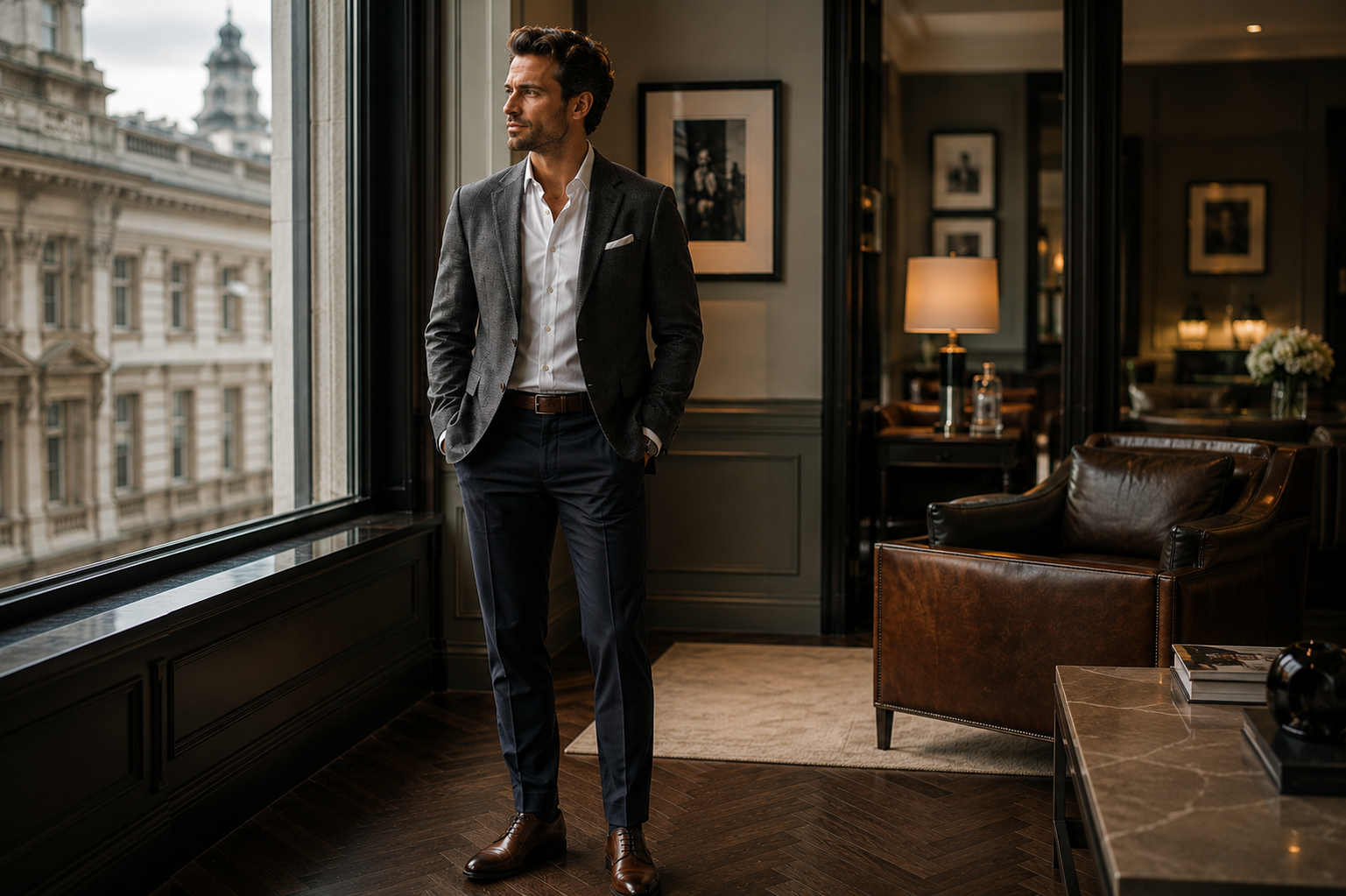
There is a significant difference between dressing appropriately for a room and dressing with authority in it. Appropriate means meeting the minimum standard. Authority means the room reads you as someone who belongs at the top of it. Most men stop at appropriate. Executive presence requires going further.
Consistency builds reputation.
Presence is not built in one outfit. It is built through the accumulated impression of how you show up every day. The man who is consistently precise, consistently well-dressed and consistently considered builds a visual reputation that precedes him into every room. That reputation is a form of authority in itself.
Every detail is part of the picture.
Hair, skin, shoe, watch, the condition of every piece. Executive presence does not survive one excellent suit and one unexamined detail. The whole picture has to be considered, not most of it.
What Executive Presence Is Not
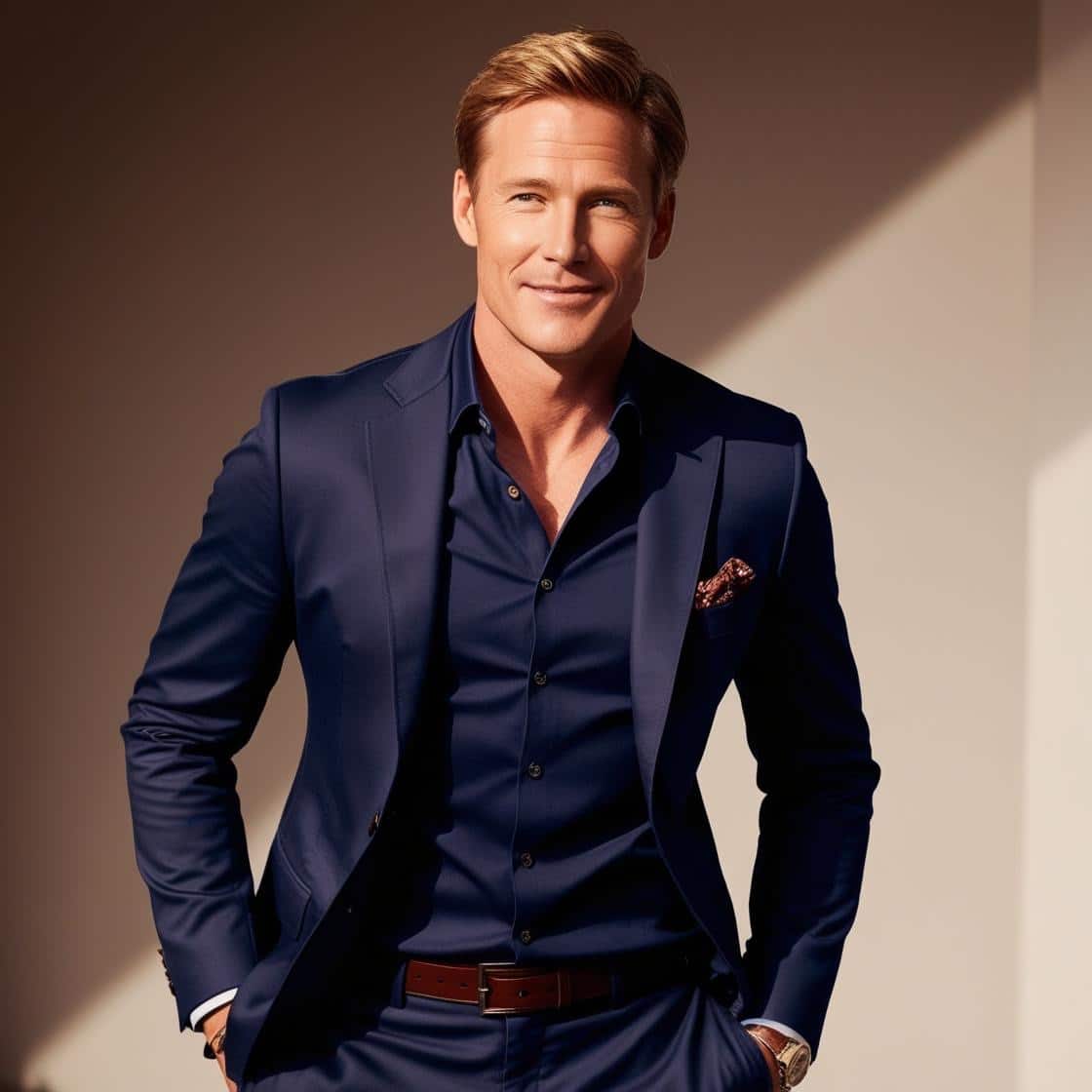
It is not expensive dressing. A man in a badly fitted suit from a prestigious label has less presence than a man in a correctly fitted suit from a high street tailor. Price does not create presence. Precision does.
It is not loudness or visual dominance. The most physically imposing or most expensively dressed man in the room is not always the one with the most authority. In British corporate culture particularly, restraint communicates confidence far more powerfully than display. The man who does not need to announce himself has already arrived.
It is not fixed. Executive presence shifts. It can be undermined by a wardrobe that has not kept pace with a career. It can be eroded by a move into a more senior role without a corresponding adjustment in how you present yourself. It can be lost in a new city, a new sector or a new professional context where the codes are different from the ones you are used to.
It can also be rebuilt. Faster than most men expect. It is not only for the boardroom. Executive presence operates everywhere a room is forming an impression of you. A client dinner. A conference. A panel appearance. A media interview. Any environment where the opinion of the people in it matters.
Dressing With Executive Presence
Dressing with executive presence is not about following rules. It is about understanding principles and applying them consistently and deliberately to your specific body, role and environment.
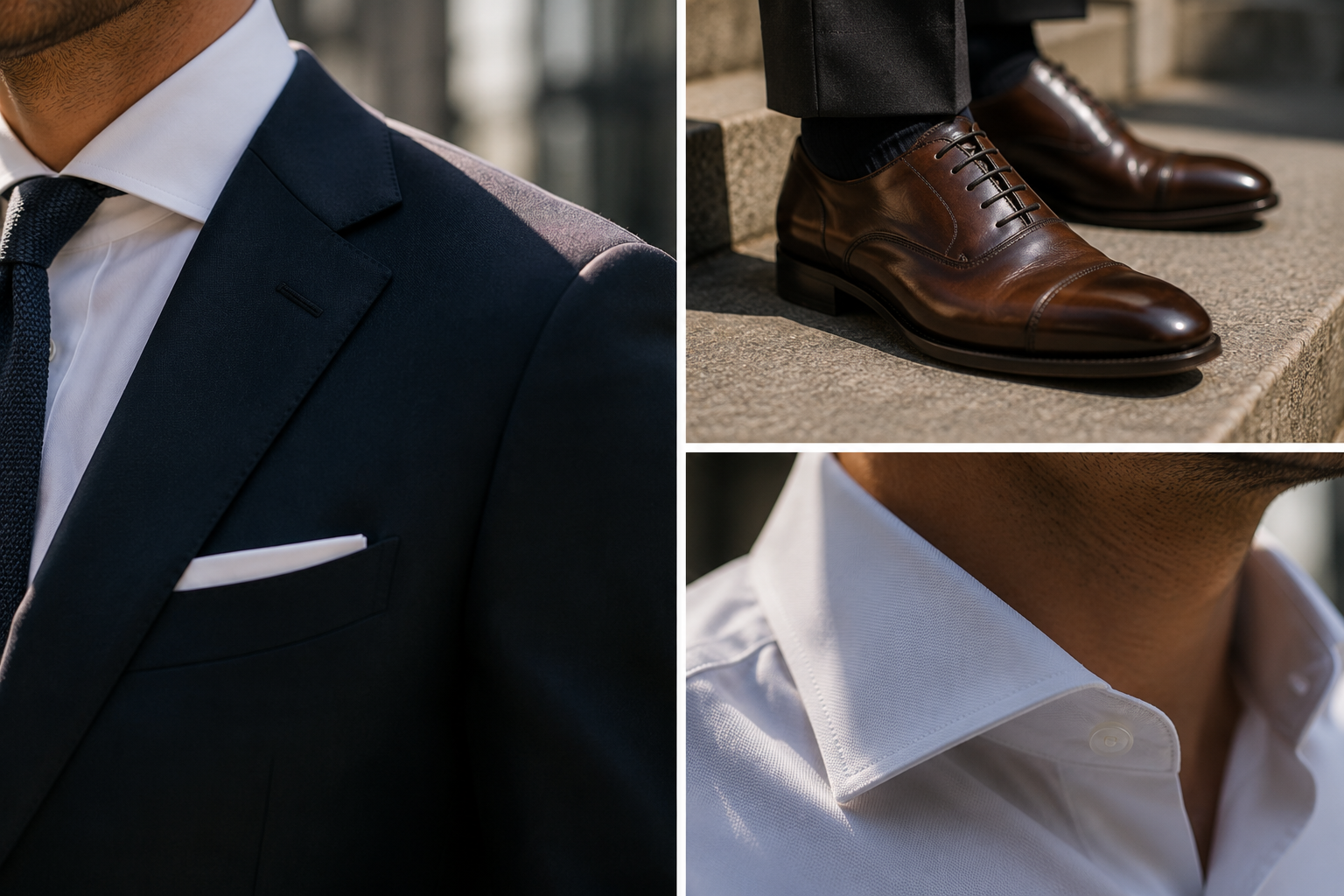
Fit comes before every other decision. No other choice you make about your wardrobe carries as much weight. The shoulder sits where your shoulder ends. The chest is clean. The trouser breaks with intention. Every line is deliberate. This is the first thing the room reads.
Your wardrobe needs to reflect the role you are in now, not the one you came from. This is the error most commonly made at the point of promotion or career transition. The clothes that worked at the previous level of your career can quietly undermine your authority at the next one. Executive presence requires your presentation to reflect where you are, not where you were.
Deliberateness matters more than comfort. Every piece you wear communicates something. The question is whether you are choosing what it communicates or leaving that to chance. A deliberately chosen outfit at any level of formality projects more authority than a comfortable but unexamined one.
And it has to be consistent. Executive presence is not something you apply on important days and relax on ordinary ones. The man who shows up precisely every day builds a visual reputation. That reputation walks into the room before he does.
Three Mistakes That Quietly Undermine Executive Presence
Dressing for your last job, not your current one
The most common and the most damaging. A man who has built his wardrobe around the dress code of a previous role, a previous city or a previous level of seniority carries the visual signature of where he has been rather than where he is. The room reads it. Nobody says anything. But the impression is formed and it costs him.
Career transitions are the moment executive presence most often needs deliberate attention. A new role, a significant promotion, a move to a different sector or city. Each one is an opportunity to ensure the wardrobe reflects the position, not just the history.
Confusing expensive with precise
A premium brand does not guarantee executive presence. A luxury label does not guarantee fit. A high price point does not guarantee that the clothes are working for the man wearing them rather than simply sitting on him.
The most authoritative man in the room is not always the most expensively dressed. He is the most deliberately dressed. Every piece chosen with an understanding of what it communicates, every fit addressed, every detail considered. That is what the room responds to. Not the label.
Neglecting the details
Executive presence is a complete picture. An excellent suit and the wrong shoe undermine the entire impression. A considered outfit and an unexamined haircut create a disconnect the room registers without being able to name. Grooming, footwear, accessories and the condition of every piece either contribute to or subtract from the overall reading the room makes.
The details are not a finishing touch. They are part of the foundation.
Executive presence is not a style concept. It is a behavioural and neurological one.
The human brain processes visual information before language. It makes social assessments automatically, rapidly and largely below the level of conscious awareness. When you walk into a room the people in it are not choosing to evaluate you. Their brains are doing it regardless, forming conclusions about your trustworthiness, competence and authority from the visual data you present.
| My methodology, The Science of Styling, is built on this understanding. The Five Level BrainFilter maps the sequence of assessments the brain makes: Safety, Relevance, Competence,Authority and Value. Your clothes are the first input into that filter. What you wear determinesthe initial reading before anything else about you has had the chance to register.
Dressing with executive presence means taking deliberate control of that first input. Ensuring thevisual data you present aligns with the authority, competence and credibility you have actually earned.
For Men Relocating to London
If you are an American professional who has recently relocated to London, executive presence carries an additional layer of complexity. The visual codes that communicate authority in the United States are not identical to the ones that operate in a British corporate environment. The fit standards are different. The dress code interpretations are different. The signals that read as confident and successful in one culture can land differently in another.
I started at the BBC in 1991 dressing on-screen talent for live broadcast television. Presenters, journalists and public figures whose credibility and authority had to be communicated in the first second of a broadcast to an audience of millions, with no adjustment possible after the camera rolled.
That environment taught me that image is performance. That precision is not a preference but a requirement. And that the difference between almost right and exactly right is the only difference that matters when the stakes are high.
A London boardroom operates to the same standard. The room reads you before you speak. I have spent nearly thirty years making sure that reading says exactly what it should.
| The only difference between broadcast and boardroom is there is no image coach waiting inthe wings.
Start With a Conversation
If you have recognised yourself somewhere in this post, if there is a gap between how you want to be perceived and how you suspect you are actually being read, that gap is solvable.
A ten-minute call costs nothing and commits you to nothing. It is a conversation about where your executive presence is right now and what it would take to build it into something that works as hard as you do.
Phill Tarling is a London-based Corporate Style Consultant and Menswear Stylist with nearly 30 years of experience.
Beginning his career at the BBC in 1991, he dressed on-screen talent for live broadcast television before transitioning into corporate image consultancy. He has worked with C-suite executives, senior leaders, TV presenters and high net worth individuals across the UK and internationally. His proprietary methodology, The Science of Styling, draws on neuroscience to explain why image directly impacts professional performance. Featured in Forbes. Heard on BBC
Successful men know every detail counts, and time is money. They leave nothing to chance—they’re constantly looking for ways to sharpen their edge. Showing up well isn’t a luxury; it’s…
Trustindex verifies that the original source of the review is Google.
Phill is nothing short of a magician for men’s style. His wardrobe redesign wasn’t just a service—it was a transformation. From head to toe, every piece he curated, every detail he adjusted, has drawn head-turning compliments. It’s not just a wardrobe; it’s a statement.
Phill doesn’t merely dress you; he educates you. The day wasn’t just about picking clothes—it was a masterclass in style, fit, and confidence. The way he demystifies fashion and aligns it with personality and purpose is both inspiring and empowering.
The feedback has been extraordinary. Friends, colleagues, and even strangers have taken notice. It’s proof of Phill’s unmatched talent and meticulous eye. If you’re looking to elevate your style and learn in the process, Phill is not just a recommendation—he’s a revelation.
Thank you!
Posted on Google
Lansing Lee
Trustindex verifies that the original source of the review is Google.
Phill is an absolute expert when it comes to style and dressing well. In our personal styling session, he was detailed, thorough, and easy to work with all the way through. He listened intently and gave really strong advice. On the day of our session together, I walked away not only with better clothes, but a lot of knew knowledge about how to style and pick out clothing myself. Really couldn't recommend this highly enough.
Posted on Google
S B
Trustindex verifies that the original source of the review is Google.
Phil was an excellent resource for helping me update my wardrobe after feeling like I’d long been neglecting my ‘look’. I work in the creative media industry, so attention to taste and style was important to me. Phil was spot on with all of his recommendations and had great advice on tailoring and fit as well. It gave me the lift i needed. If you’re on the fence at all, I would say don't hesitate to give him a call. Was well worth it for me!
Posted on Google
Sheena Holton
Trustindex verifies that the original source of the review is Google.
Loved working with Phil!! He has such a high level of expertise and puts you at ease from the word go. I really appreciated his honest approach and have loved the changes we made in my wardrobe as a result of his feedback. He really cares about making you feel good and it shows in both the process and the end result!
Posted on Google
Tom S
Trustindex verifies that the original source of the review is Google.
Phill is that rare thing, someone who is top quality in his field, and also a truly decent person who is very enjoyable to spend time with. He not only clearly knows his stuff, sharing his expertise and insight (and passing on discounts where possible), but also provides access to his network built up over many, many years. Combined with his balanced, no ego, clear style this creates a great experience. He is also highly attuned to the bespoke nature of what each person is looking for and it was without doubt therefore a 5 star service for me which I strongly reccomend to others considering it (with most efficiency and impact gained from starting with a wardrobe edit followed by a styling session).
Posted on Google
Peter McCammon
Trustindex verifies that the original source of the review is Google.
I had a consultation with Phill in March 2024. I am 55 years old and had never done anything like this before. From start to finish I had an brilliant experience working with Phill. The whole process is well thought through. By the time we met in London Phill was really clear on what I wanted and he delivered with professionalism and enthusiasm. Phill is a also a great guy and I really enjoyed my time with him. My wardrobe is transformed forever and how I think about dressing myself has also transformed. I am delighted with the outcome and so is my wife. I have no hesitation in highly recommending Phill Tarling.
Posted on Google
A P
Trustindex verifies that the original source of the review is Google.
I was looking for a Birthday gift for my partner. I approached Phill, and he has performed nothing short of a miracle.
It is safe to say that I have never seen my other half return from a shopping session energised - let alone hear him say that he now knows what to buy, what to wear and how to combine everything to the best effect.
Thanks to Phill and his magic, my partner has gone from depressed and dejected to confident and effortlessly stylish over the course of one day.
Phill, thank you once again for having made him see his true potential. To say your effect has been transformational is an understatement.
Posted on Google
Pete Deemer
Trustindex verifies that the original source of the review is Google.
I can't recommend Phill highly enough -- I love the wardrobe he helped me put together -- it really feels like "me", and the experience was enjoyable from start to finish. Looking forward to doing this again with Phill!
Posted on Google
Hugh Millington
Trustindex verifies that the original source of the review is Google.
Phill Tarling is an exceptional stylist and a wonderful person, and I can't recommend him highly enough. Phill was the stylist for our photoshoot in July 2022, at the recommendation of the photographer. Having not done that kind of shoot before, I was unsure of what to expect but I was amazed at how much Phill added to the experience and the results.
In the weeks leading up to the photoshoot, Phill was on hand by phone whenever we needed him, and he gave invaluable advice regarding our clothes and extra items we could get to make the most of the day. On the day, I was blown away by Phill's commitment and the incredible advice he gave. This included hearing our goals of how we wanted to present ourselves; giving his expert advice regarding how we could subtly elevate our styling, both as individuals as an ensemble; to choosing outfits that really made us look confident and feel incredible.
Phill also spent so much time helping prepare the outfits, and was with us throughout the day, helping me feel confident in front of the camera. I couldn't be happier with the results of the photoshoot, and I have so much to thank Phill for: the effects of his styling have led me to be excited about clothes and styling, and the confidence he instilled into me during the day has stayed with me. I feel more confident and comfortable within myself than ever, and I really have Phill to thank for this.
Posted on Google
Stefan Germann
Trustindex verifies that the original source of the review is Google.
I found Phil via a google search and planned with him to meet up on my next London trip (I live in Switzerland). His support was amazing, it was a very personalized styling experience as I like a minimalist, essential set of outfits that mix and match well. After meeting on Wednesday to go over the online pre-questionnaire, Phil then prepared all in 4 shops for a 4 hour session on Saturday morning. He is highly professional and has great relationships with staff in the shops. He is conscious of a clients budget etc. At no time did I feel pressured but the whole styling and shopping experience was fun and at the end I am getting great compliments on my wardrobe upgrade. Thank you Phil, warmly Stefan
This website uses cookies to improve your experience. We'll assume you're ok with this, but you can opt-out if you wish.AcceptRead More
Privacy & Cookies Policy
Privacy Overview
This website uses cookies to improve your experience while you navigate through the website. Out of these, the cookies that are categorized as necessary are stored on your browser as they are essential for the working of basic functionalities of the website. We also use third-party cookies that help us analyze and understand how you use this website. These cookies will be stored in your browser only with your consent. You also have the option to opt-out of these cookies. But opting out of some of these cookies may affect your browsing experience.
Necessary cookies are absolutely essential for the website to function properly. This category only includes cookies that ensures basic functionalities and security features of the website. These cookies do not store any personal information.
Any cookies that may not be particularly necessary for the website to function and is used specifically to collect user personal data via analytics, ads, other embedded contents are termed as non-necessary cookies. It is mandatory to procure user consent prior to running these cookies on your website.