
style guide to SS15 trends
I have many years of experience styling real people with real bodies. Whatever the gospel according to the glossies is, or whatever the current crush or trend -remember THIS –…


This is part two of a series written specifically for American professionals relocating to London for corporate roles. Part one,
Why Your American Wardrobe Is Not Working in London, unpacks the psychology behind the disconnect. This post is the practical guide. It works as a standalone read, but both together give you the full picture.
You are not new to this. You have built a career on showing up well prepared, projecting confidence and understanding that how you present yourself is part of the job. You have always known that image matters.
What nobody told you before you landed in London is that the visual language is different here. Not dramatically. Subtly. And subtle is harder to read and harder to fix on your own.
This post gives you the framework. It maps the dress codes, the key pieces and the decisions that separate a wardrobe that works from one that almost works. Almost right costs you more than you think in a London room.

American corporate dressing, across banking in Charlotte, pharma in New Jersey, tech in San Francisco, consulting in Chicago or finance in Houston, is built on projection. Presence. The suit that commands the room. The accessories that signal achievement. These are not mistakes. In the context of American business culture, they are the right signals entirely.
British corporate dressing operates on a different principle. Precision over projection. Restraint over display. The suit that fits exactly, in a fabric that speaks for itself, worn by a man who does not need the room to notice him because the room already has.
Neither approach is wrong. But only one of them is being read by the room you are now in every single day. And the gap between the two is wider than it looks from the outside.
You are not badly dressed. You are dressed for the wrong city. There is an important difference between those two things.
The words are the same. The meaning is not. This is where most relocating men lose ground without knowing why.
Business Formal in a London Office
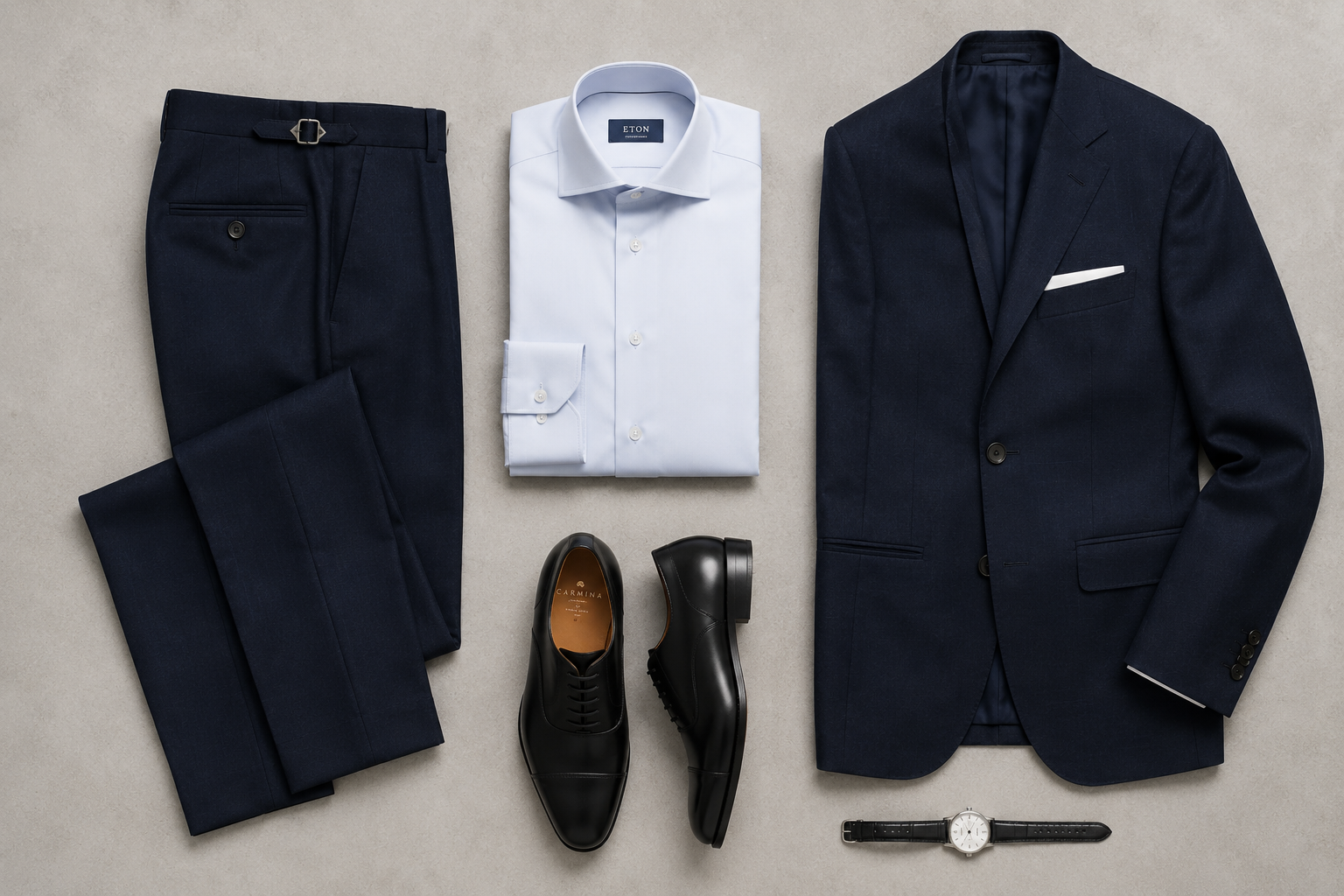
A tailored suit in navy, charcoal or mid-grey. A plain or subtly patterned shirt. A quality leather shoe. The tie is optional in many environments but if you are in any doubt, wear one. This is the standard in the City of London, in law, in investment banking and at partner level in consulting. It does not flex.
What Business Casual Actually Means in the UK
This is the code that catches American professionals most consistently, regardless of industry or seniority.
In London, business casual means tailored trousers, a well-fitted shirt and a quality leather shoe. The blazer may be on or off. The tie is usually gone. But the standard of every individual piece remains high and the overall impression remains deliberate and considered.
It does not mean what it means back home. The combination that reads as perfectly dressed across most American corporate environments reads as underdressed in a London business casual context. That gap between two valid interpretations of the same phrase is quiet, persistent and damaging.
Smart Casual: the Most Misread Dress Code in London
Smart is the operative word. Casual describes the occasion. It does not lower the standard.
Imagine walking into your London office on a smart casual Friday in the outfit you would have worn to a relaxed client lunch back home. Chinos, a quality polo, clean trainers. You feel appropriately dressed. The room reads something different. Nobody says a word. That silence is the gap.
I have written in depth about what smart casual actually means for professional men and how to look sharp without wearing a suit. Both posts are worth reading before your first London Monday morning.
Before any specific piece, understand this.
In British corporate menswear, fit communicates more than any brand, any price point or any label. The shoulder sits precisely. The chest is clean. The trouser break is intentional. Every line is exact.
American tailoring, even at the premium end, tends to run slightly more generous through the shoulder, the chest and the body length. A suit that fitted well in your previous city can read as slightly over-sized to a London eye. Not scruffy. Not inappropriate. Just fractionally off. And fractionally off is enough to undermine an otherwise strong impression in a room full of people who have been calibrated to this standard their entire careers.
A suit that costs twice as much but fits slightly wrong will always lose to a suit that costs half as much and fits exactly right. London reads the fit first.
I have written a practical guide to men’s essential measurements and how to assess your own fit. Start there before you spend anything on new pieces.

This is one of the most misunderstood pieces in American corporate dressing, and getting it wrong is more visible than most men realise.
A blazer has structure. Particularly through the shoulder. That structure is not aesthetic. It is functional. It creates a clean, authoritative line across the top of the body that a soft or unstructured jacket simply cannot deliver. For many men, and particularly for those with a fuller or rounder build, that shoulder structure is the difference between a jacket that squares off the frame and anchors the silhouette and one that follows the body without correcting it.
A sports jacket is a different garment entirely. Relaxed in construction, often patterned, built for weekends and the country. In American wardrobes the two are sometimes used interchangeably. In a London corporate environment, that interchangeability is read by the room.
A well-chosen blazer in navy, grey or camel, properly structured through the shoulder and correctly fitted to your frame, moves across almost every dress code you will encounter in a London corporate week. It is one of the highest-return investments in a professional wardrobe.
A fine merino or cashmere crew neck or V-neck is a powerful piece in a London wardrobe, particularly through the long autumn and winter months. Paired with tailored trousers and a quality leather shoe it reads as considered, appropriate and exactly right across most London corporate environments.
Fabric quality matters here more than almost any other variable. A cheap knit reads immediately in a London room. A quality one does not draw attention to itself. It simply reads well.
Think about the last time you noticed someone’s knitwear for the wrong reasons. That is the gap a quality piece closes permanently.
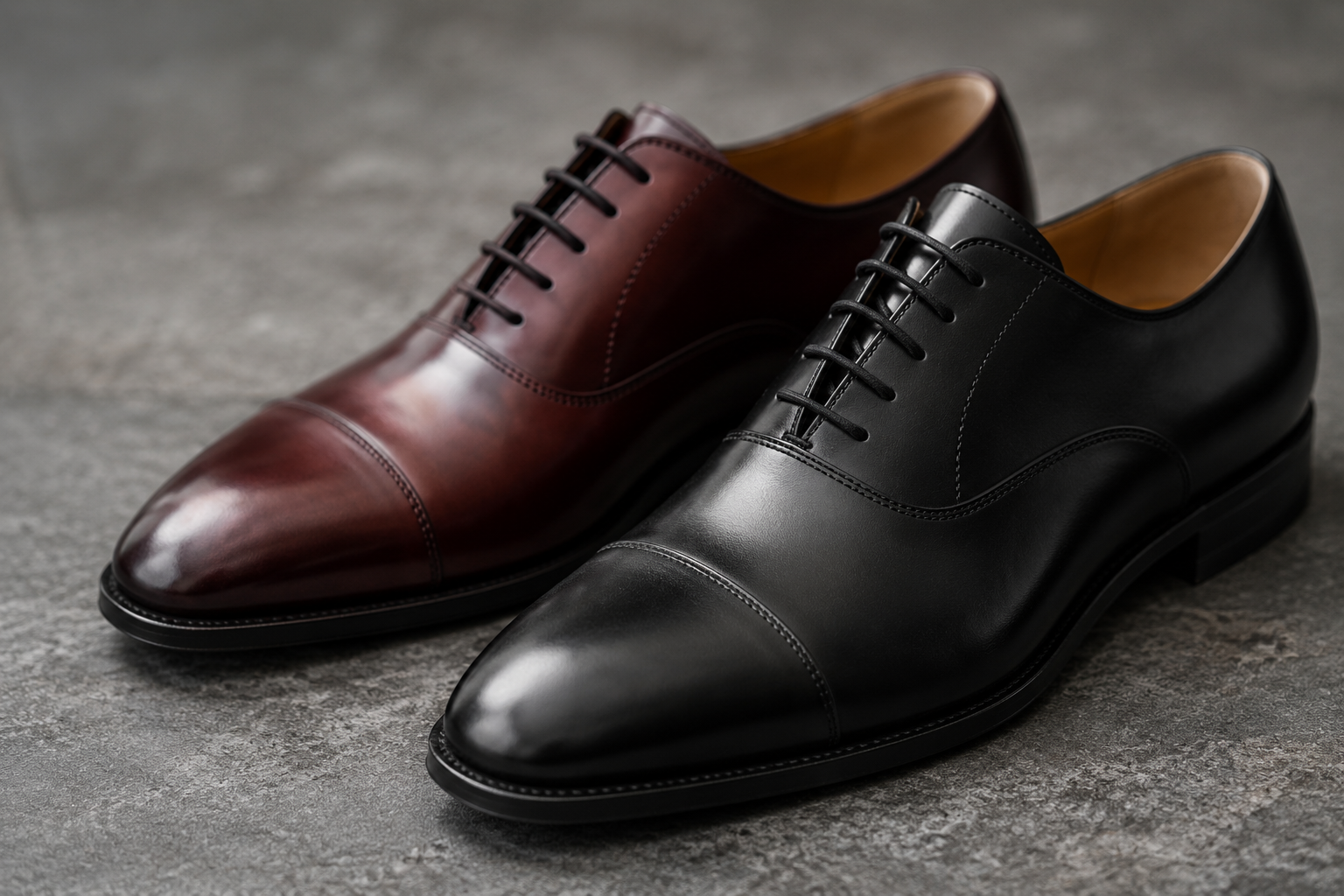
Nothing reveals an American wardrobe in a London office faster than the wrong shoe. This is the detail that surprises most men when I point it out, and the one that makes the most immediate difference when it is corrected.
The standard is clean, classic leather. Oxford, Derby, brogue or loafer in black, dark tan or mid-brown. British heritage shoemaking is the reference point. The brands worth knowing are not the ones with logos on the side.
And then there is oxblood.
An oxblood shoe sits between brown and black. A deep, rich burgundy-red that works with navy, charcoal and grey in a way that neither brown nor black achieves alone. It is a considered colour choice. A quiet signal that the man wearing it has paid genuine attention to the craft of dressing rather than simply assembled the components. In a London corporate room, that distinction is noticed even when nobody mentions it. It is the kind of detail that separates a well-dressed man from a precisely dressed one.
British corporate style is anchored in heritage, craft and restraint. The reference points are Savile Row tailoring, British shoemaking traditions, quality cloth woven in Scotland and Yorkshire. These are not luxury status signals in the American sense. They are a quiet, confident commitment to quality over display.
The man who understands this does not need a visible brand or a recognisable logo to communicate his position. The quality of what he is wearing does that work silently, to the people in the room who can read it.
American style, across every industry and every major corporate city, tends to communicate success through visibility. British style communicates it through precision. Both are valid. But in a London room, only one of them lands correctly.
Your investment in quality, your understanding that image is part of performance, your instinct that how you show up matters. All of that is exactly right. The translation is what needs work.
For a deeper look at how executive presence operates at senior level and why visual credibility directly affects how you are perceived in a room, read this post.
I started at the BBC in 1991. Live television is unforgiving. The image has to be exactly right before the camera rolls because there is no adjustment after it. No second impression. No almost right.
The standard is precision. It is the only standard that exists in that environment and it is the same standard a London boardroom operates at. The room reads you before you speak. I have spent nearly thirty years making sure that first reading says exactly what it should.
You now understand the territory. The dress codes, the key pieces, the signals that London reads and the ones it does not.
If something in this post has resonated, if you have recognised yourself in any of it, or if you have a specific question about your wardrobe, your sector or where to start, get in touch. Send me a message directly or book a ten-minute call. No commitment, no pressure. Just a conversation.
Most men who have that call leave it knowing exactly what needs to change and feeling considerably better about the week ahead.
And if you are not quite ready to talk yet, keep reading. Every question you are sitting with right now has an answer.
Book your ten-minute call or send a question directly at philltarling.com.
Further Reading on philltarling.com
Why Your American Wardrobe Is Not Working in London
Men’s Essential Measurements: The Complete Fit Guide
Smart Casual Dressing for the Modern Professional
How to Look Sharp Without Wearing a Suit
Executive Presence: Why What You Wear Directly Impacts How You Perform
About Phill Tarling
Phill Tarling is a London-based Corporate Style Consultant and Menswear Stylist with nearly 30 years of experience. Beginning his career at the BBC in 1991, he has worked with C-suite executives, senior leaders, TV presenters and high net worth individuals across the UK and internationally. His proprietary methodology, The Science of Styling, draws on neuroscience to explain why image directly impacts professional performance. Featured in Forbes. Heard on BBC Breakfast and Times Radio.
philltarling.com | @philltarling