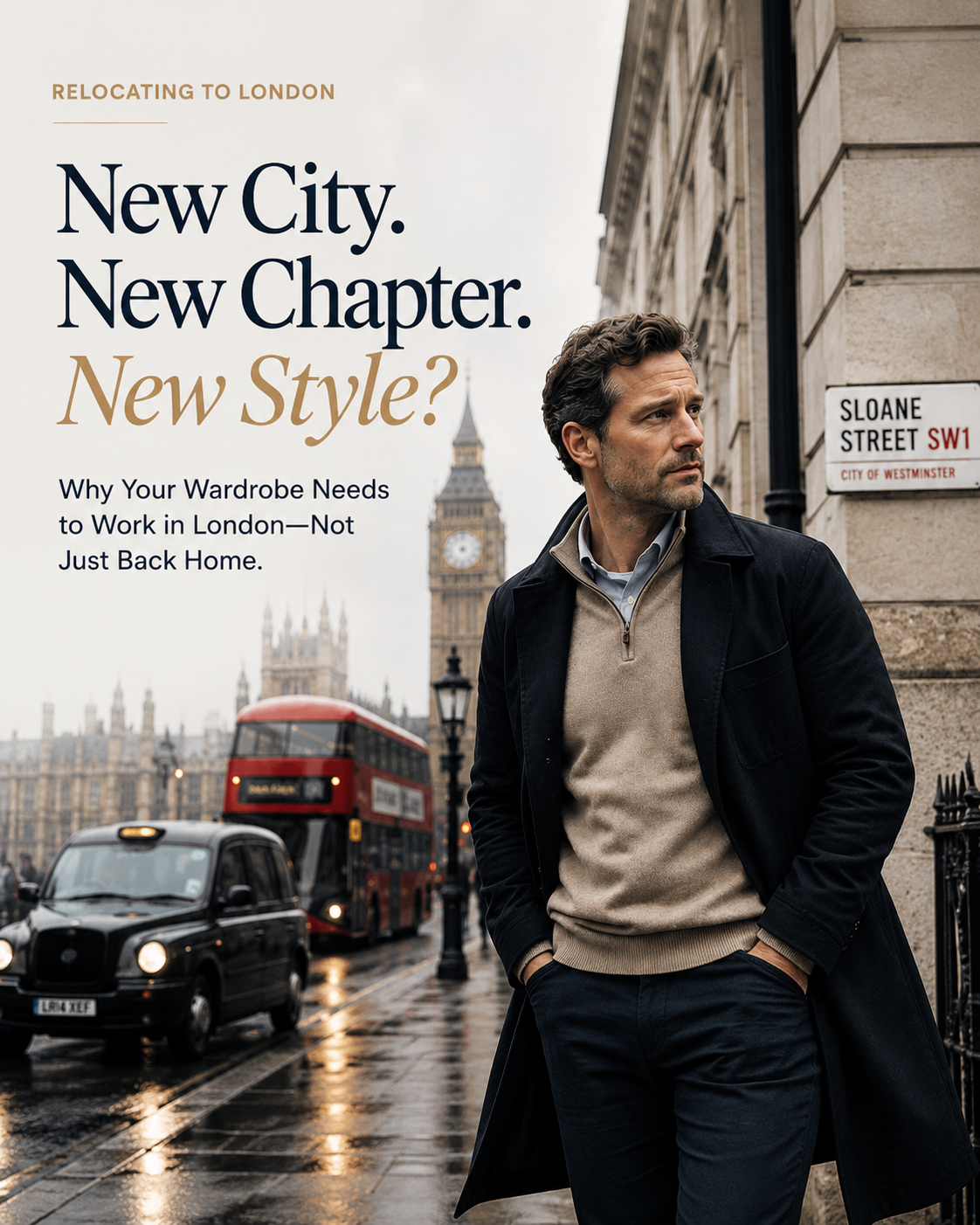
Why Your American Wardrobe Is Not Working in London
Relocating is one of the most demanding things you will ever do. You are not just moving your address. You are moving your entire life. Your home, your routines, your professional network, your sense of belonging. And somewhere between the flight and the first Monday morning in your new London office, something stops working.
Not your performance. Not your intelligence. Not your track record.
Your wardrobe.
The style gap between America and the UK is real. It catches almost every American man off guard, and it catches the most successful ones the hardest, because they are the least likely to expect it. What worked in New York, Chicago, Dallas or San Francisco. What made you look sharp, credible and put together can land very differently in a London boardroom.
And here is what makes it harder. Nobody tells you. Your colleagues are polite. The diary is full. You are performing at senior level in a new organisation, under scrutiny, trying to build trust and credibility fast. Your wardrobe is the last thing you have time to think about.
But it is the first thing the room reads.
The Invisible Disconnect
Let me be clear about something. You are not badly dressed. You are dressed for the wrong city.
There is an important difference between those two things, and understanding it is the first step to resolving it.
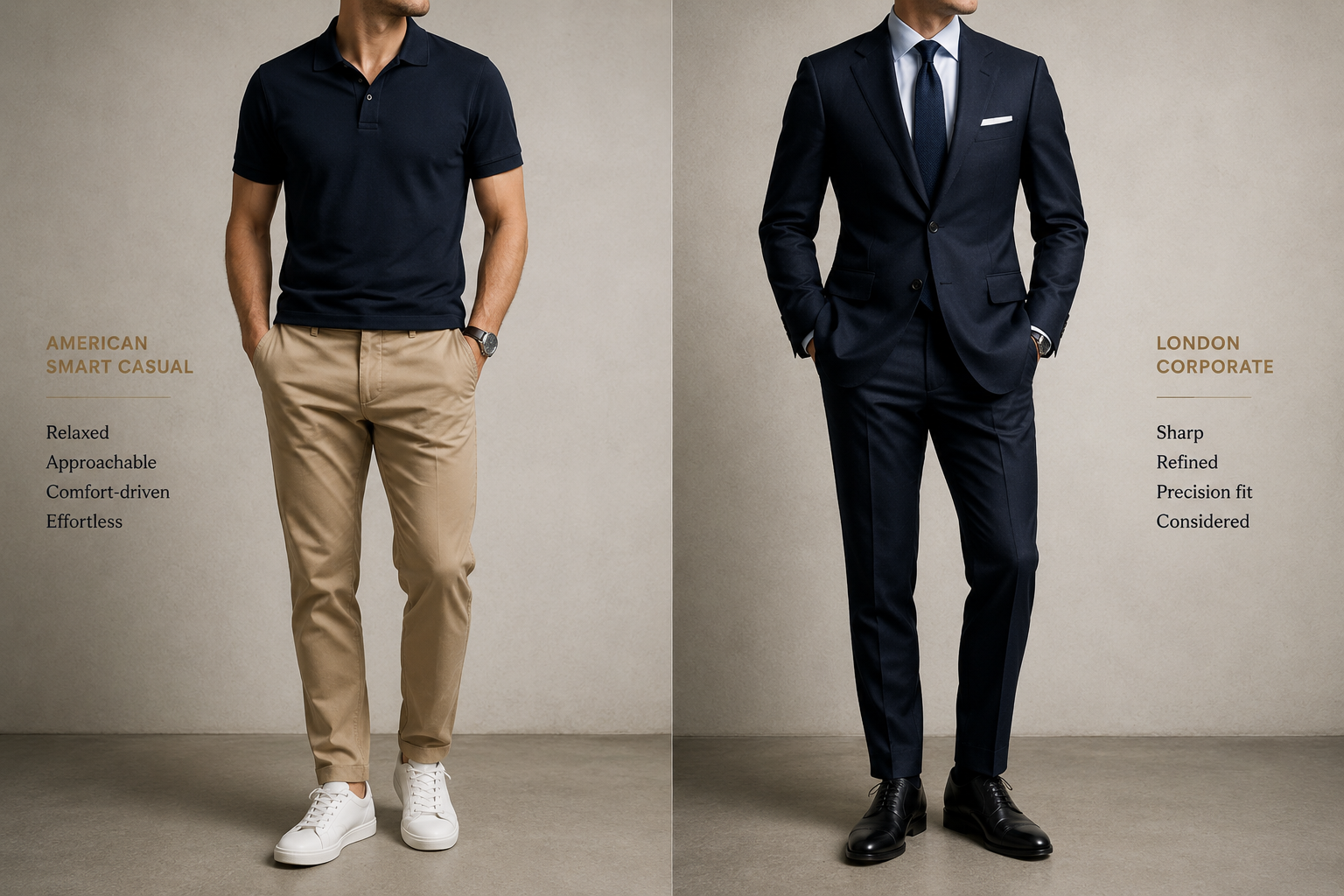
American corporate style is built on projection and presence. The suit that commands attention. The confident fit that fills the room. The accessories that signal achievement. These are not mistakes. In the context of American business culture, they are absolutely the right signals to send.
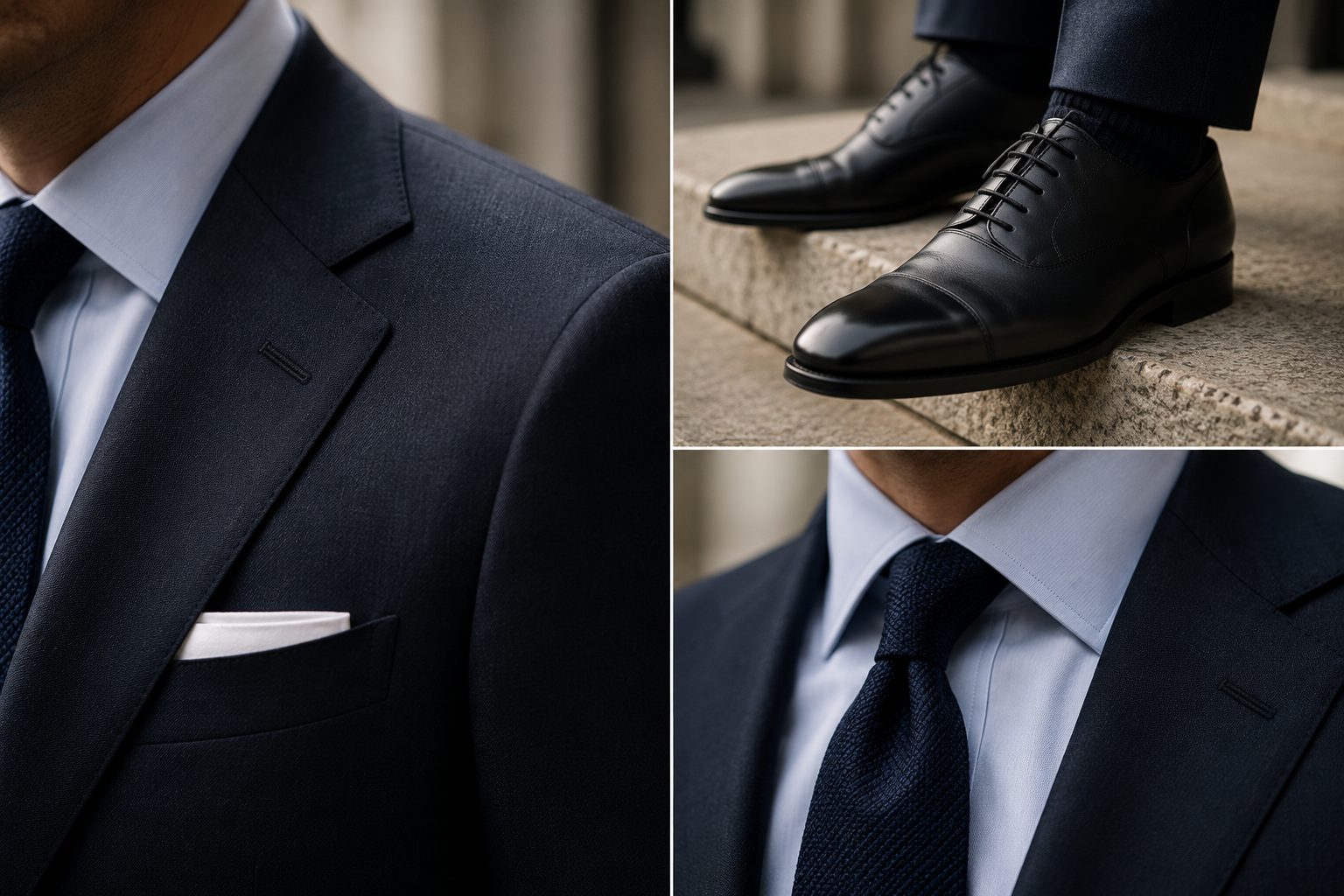
British corporate style operates on a completely different logic. It is built on precision and restraint. The suit that fits exactly. The shoe that is quietly excellent. The ensemble that communicates taste without announcing it. Understatement is not a failure of confidence here. It is the highest form of it.
Neither approach is wrong. But one of them is being read by a London room, and if you arrived with the other one, the room has already formed an impression before you have opened your mouth.
What the Room Reads Before You Speak
This is not subjective. It is neuroscience.
The human brain processes visual information and makes social judgements in under a second. Your colleagues, your clients, your peers are not consciously evaluating your clothes. They are running an automatic filter that makes instant assessments about your credibility, your cultural literacy and your seniority level.
I call this the Five Level Brain Filter, and it is at the heart of my Science of Styling methodology. The clothes you wear are not decoration. They are data. The question is what data they are transmitting, and whether that data matches the position you are in and the credibility you need to project.
In a London corporate environment, that filter is calibrated to specific signals: fit, fabric quality, restraint, and an understanding of British professional codes. An American wardrobe, however expensive and however well assembled for its original context, can inadvertently transmit the wrong data entirely.
The result is a subtle but persistent sense that something is not quite landing. You feel it. You just cannot name it.
The Three Specific Pain Points
1. The Fit Problem
American menswear, even at the premium end, tends to run larger in the shoulder, wider through the chest and longer in the body. The cut is generous. The silhouette is built for comfort and physical presence.
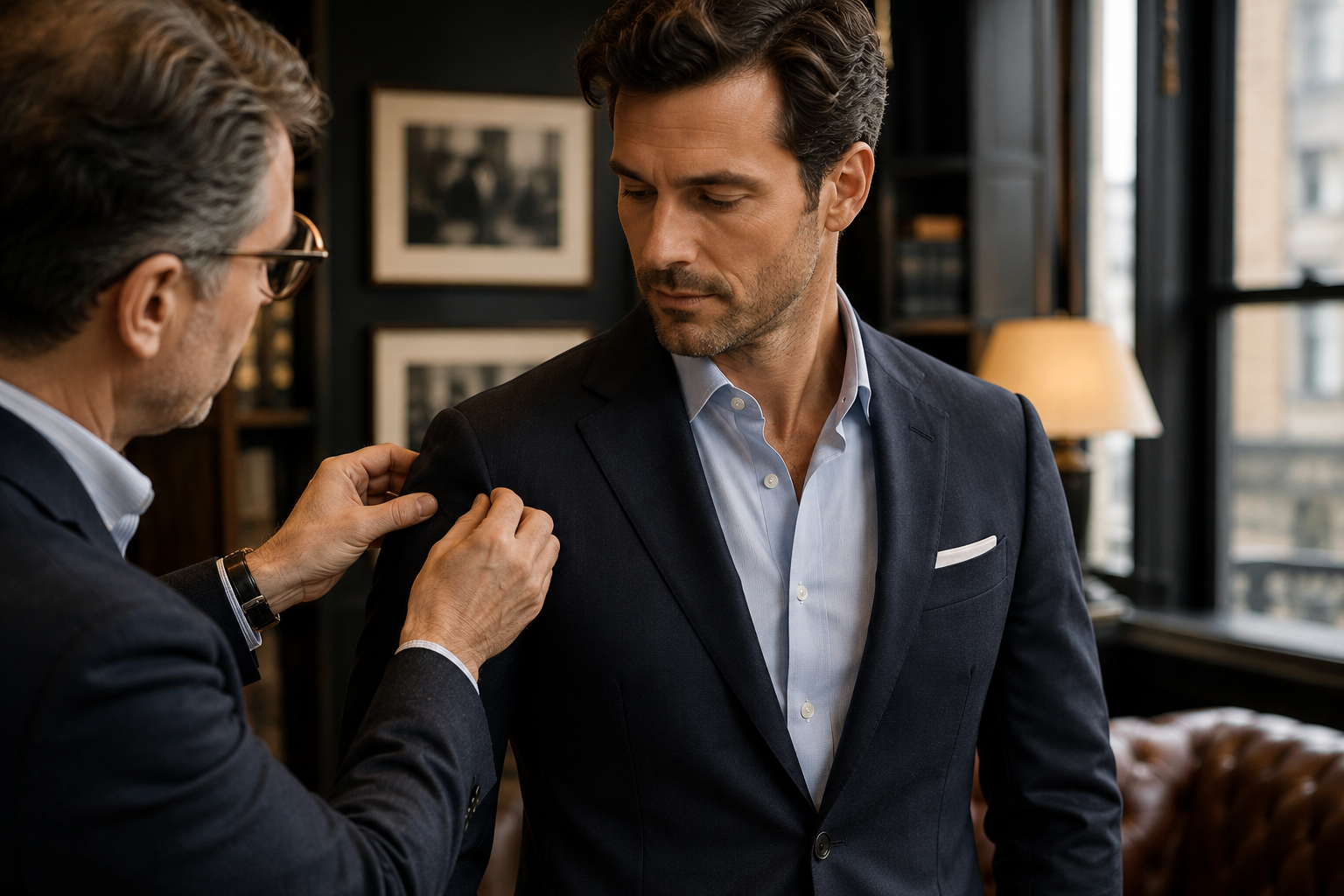
British corporate tailoring is closer to the body. Shoulders sit more precisely. The chest is clean rather than expansive. Trousers break higher. The overall silhouette is leaner, more deliberate, more exact.
A well-fitting American suit often reads, to a trained London eye, as slightly over-sized. Not scruffy. Not inappropriate. Just slightly off. And in a city where fit is the foundational signal of taste, slightly off is enough to create a gap between how you look and how you want to be perceived.
2. The Smart Casual Misread
Smart casual in London is not smart casual in the United States. This is one of the most common and most damaging wardrobe mistakes American men make when they relocate.
In most American corporate environments, smart casual has shifted to mean quality chinos, a good polo or open-collar shirt, and clean footwear. That reads as appropriately dressed across a huge range of US offices.
In London’s financial district, professional services firms and the broader corporate world, the same outfit can read as underdressed for the room. The stated dress code may say casual. But walk through the building and you will find that the majority of men are still in tailored trousers, a properly fitted shirt and a quality shoe at minimum. The tie may be gone. The suit jacket may be off. But the standard is categorically higher than the American equivalent.
The man who arrives dressed by American smart casual standards walks in looking fine by the rules he knows and immediately feels the gap he cannot articulate.
3. The Logo and Label Trap
American corporate style at the luxury end tends to carry visible signals of success. The recognisable brand name. The prominent logo. The status piece worn with intention. These signals are culturally understood in the US as markers of achievement. They communicate that you have arrived.
London’s corporate world reads this very differently. The operating principle here is that the quality speaks for itself, quietly, to those who know. The suit is from a tailor whose name you would only recognise if you knew the world. The shoes are a British heritage brand with no logo on the side. The whole ensemble communicates taste through restraint rather than display.
An American man can arrive having spent significantly more on his wardrobe than his British colleagues and still look, to London eyes, like someone who is new to the codes. The irony is real. The solution is not about spending more. It is about spending differently, and understanding what signals you are actually sending.
What Resolution Looks Like
Here is the good news. This is not a taste problem. It is a translation problem.
You have already built the instincts, the discipline and the investment mindset that makes a great wardrobe possible. What you need is a London translation of what you already know. A clear picture of where the standards sit, what the signals mean, and exactly what to add, adjust and retire from your current wardrobe to close the gap.
This is precisely what I do. I have worked with senior men, executives, TV presenters and C-suite leaders for nearly 30 years. I understand both the American and the British corporate codes at the highest level. Over 50 per cent of my personal styling clients are American men who have relocated to London. I have sat in the same conversation you are in right now, dozens of times, with men who are exceptional at what they do and simply need a trusted expert to calibrate their wardrobe for a new city.
The result is not a new wardrobe. It is a recalibrated one. And the confidence that comes with walking into a London room knowing you have got it right.
Ready to Close the Gap?
If you have landed in London and something does not feel quite right, you are not imagining it. And you do not have to figure it out alone.
Book a consultation at philltarling.com and let us get this right from the start.
Want to go deeper? Read my next post:
How to Dress for London Corporate Life: A Practical Guide for American Men
About Phill Tarling
Phill Tarling is a London-based Corporate Style Consultant and Menswear Stylist with nearly 30 years of experience. Beginning his career at the BBC in 1991, Phill has worked with C-suite executives, senior leaders, TV presenters and high net worth individuals across the UK and internationally.
His proprietary methodology, The Science of Styling, draws on neuroscience to explain why what you wear directly impacts how you perform.
Clients include TV presenter Ben Shephard, with whom Phill has worked for nearly 20 years.
Britons are saying ‘so-long’ to the pandemic loungewear and causals with a return to dressing-up again. Google search terms for ‘tailoring are up 600% and now back at 2019 levels.…
Trustindex verifies that the original source of the review is Google.
Phill is nothing short of a magician for men’s style. His wardrobe redesign wasn’t just a service—it was a transformation. From head to toe, every piece he curated, every detail he adjusted, has drawn head-turning compliments. It’s not just a wardrobe; it’s a statement.
Phill doesn’t merely dress you; he educates you. The day wasn’t just about picking clothes—it was a masterclass in style, fit, and confidence. The way he demystifies fashion and aligns it with personality and purpose is both inspiring and empowering.
The feedback has been extraordinary. Friends, colleagues, and even strangers have taken notice. It’s proof of Phill’s unmatched talent and meticulous eye. If you’re looking to elevate your style and learn in the process, Phill is not just a recommendation—he’s a revelation.
Thank you!
Posted on
Lansing Lee
Trustindex verifies that the original source of the review is Google.
Phill is an absolute expert when it comes to style and dressing well. In our personal styling session, he was detailed, thorough, and easy to work with all the way through. He listened intently and gave really strong advice. On the day of our session together, I walked away not only with better clothes, but a lot of knew knowledge about how to style and pick out clothing myself. Really couldn't recommend this highly enough.
Posted on
S B
Trustindex verifies that the original source of the review is Google.
Phil was an excellent resource for helping me update my wardrobe after feeling like I’d long been neglecting my ‘look’. I work in the creative media industry, so attention to taste and style was important to me. Phil was spot on with all of his recommendations and had great advice on tailoring and fit as well. It gave me the lift i needed. If you’re on the fence at all, I would say don't hesitate to give him a call. Was well worth it for me!
Posted on
Sheena Holton
Trustindex verifies that the original source of the review is Google.
Loved working with Phil!! He has such a high level of expertise and puts you at ease from the word go. I really appreciated his honest approach and have loved the changes we made in my wardrobe as a result of his feedback. He really cares about making you feel good and it shows in both the process and the end result!
Posted on
Tom S
Trustindex verifies that the original source of the review is Google.
Phill is that rare thing, someone who is top quality in his field, and also a truly decent person who is very enjoyable to spend time with. He not only clearly knows his stuff, sharing his expertise and insight (and passing on discounts where possible), but also provides access to his network built up over many, many years. Combined with his balanced, no ego, clear style this creates a great experience. He is also highly attuned to the bespoke nature of what each person is looking for and it was without doubt therefore a 5 star service for me which I strongly reccomend to others considering it (with most efficiency and impact gained from starting with a wardrobe edit followed by a styling session).
Posted on
Peter McCammon
Trustindex verifies that the original source of the review is Google.
I had a consultation with Phill in March 2024. I am 55 years old and had never done anything like this before. From start to finish I had an brilliant experience working with Phill. The whole process is well thought through. By the time we met in London Phill was really clear on what I wanted and he delivered with professionalism and enthusiasm. Phill is a also a great guy and I really enjoyed my time with him. My wardrobe is transformed forever and how I think about dressing myself has also transformed. I am delighted with the outcome and so is my wife. I have no hesitation in highly recommending Phill Tarling.
Posted on
A P
Trustindex verifies that the original source of the review is Google.
I was looking for a Birthday gift for my partner. I approached Phill, and he has performed nothing short of a miracle.
It is safe to say that I have never seen my other half return from a shopping session energised - let alone hear him say that he now knows what to buy, what to wear and how to combine everything to the best effect.
Thanks to Phill and his magic, my partner has gone from depressed and dejected to confident and effortlessly stylish over the course of one day.
Phill, thank you once again for having made him see his true potential. To say your effect has been transformational is an understatement.
Posted on
Pete Deemer
Trustindex verifies that the original source of the review is Google.
I can't recommend Phill highly enough -- I love the wardrobe he helped me put together -- it really feels like "me", and the experience was enjoyable from start to finish. Looking forward to doing this again with Phill!
Posted on
Hugh Millington
Trustindex verifies that the original source of the review is Google.
Phill Tarling is an exceptional stylist and a wonderful person, and I can't recommend him highly enough. Phill was the stylist for our photoshoot in July 2022, at the recommendation of the photographer. Having not done that kind of shoot before, I was unsure of what to expect but I was amazed at how much Phill added to the experience and the results.
In the weeks leading up to the photoshoot, Phill was on hand by phone whenever we needed him, and he gave invaluable advice regarding our clothes and extra items we could get to make the most of the day. On the day, I was blown away by Phill's commitment and the incredible advice he gave. This included hearing our goals of how we wanted to present ourselves; giving his expert advice regarding how we could subtly elevate our styling, both as individuals as an ensemble; to choosing outfits that really made us look confident and feel incredible.
Phill also spent so much time helping prepare the outfits, and was with us throughout the day, helping me feel confident in front of the camera. I couldn't be happier with the results of the photoshoot, and I have so much to thank Phill for: the effects of his styling have led me to be excited about clothes and styling, and the confidence he instilled into me during the day has stayed with me. I feel more confident and comfortable within myself than ever, and I really have Phill to thank for this.
Posted on
Stefan Germann
Trustindex verifies that the original source of the review is Google.
I found Phil via a google search and planned with him to meet up on my next London trip (I live in Switzerland). His support was amazing, it was a very personalized styling experience as I like a minimalist, essential set of outfits that mix and match well. After meeting on Wednesday to go over the online pre-questionnaire, Phil then prepared all in 4 shops for a 4 hour session on Saturday morning. He is highly professional and has great relationships with staff in the shops. He is conscious of a clients budget etc. At no time did I feel pressured but the whole styling and shopping experience was fun and at the end I am getting great compliments on my wardrobe upgrade. Thank you Phil, warmly Stefan
This website uses cookies to improve your experience. We'll assume you're ok with this, but you can opt-out if you wish.AcceptRead More
Privacy & Cookies Policy
Privacy Overview
This website uses cookies to improve your experience while you navigate through the website. Out of these, the cookies that are categorized as necessary are stored on your browser as they are essential for the working of basic functionalities of the website. We also use third-party cookies that help us analyze and understand how you use this website. These cookies will be stored in your browser only with your consent. You also have the option to opt-out of these cookies. But opting out of some of these cookies may affect your browsing experience.
Necessary cookies are absolutely essential for the website to function properly. This category only includes cookies that ensures basic functionalities and security features of the website. These cookies do not store any personal information.
Any cookies that may not be particularly necessary for the website to function and is used specifically to collect user personal data via analytics, ads, other embedded contents are termed as non-necessary cookies. It is mandatory to procure user consent prior to running these cookies on your website.